The pn Junction

The pn Junction


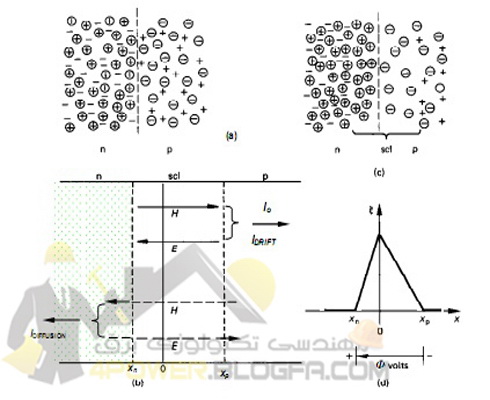
The diode is the simplest bipolar semiconductor device. It comprises p-type and n-typesemiconductor
materials brought together, usually after diffusion or implantation, to form a (step or abrupt) junction as shown in figures 2.1a and 2.3a.


دانلود مقاله

پسورد : 4power

Switching-aid Circuits with Energy Recovery

Switching-aid Circuits with Energy Recovery

Passive turn-on and turn-off snubber circuits for the IGBT transistor, the GCT and the GTOthyristor have been considered in chapter 7. These snubber circuits modify the device I-V switching trajectory and in so doing reduce the device transient losses. Snubber circuit action involves temporary energy stored in either an inductor or capacitor. In resetting these passive components it is usual to dissipate the stored energy in a resistor as heat. At high frequencies  these losses (being proportional to frequency) may become a limiting factor because of the difficulties  associated with equipment cooling. Instead of dissipating the switching-aid circuitstored energy, it may be viable to recover the energy back into the dc supply or into the load, or both. Two classifications of energy recovery circuits exist, either passive or active. A  passive recovery  circuit involves only passive components such as  L  and  C  while  active recovery techniques involve extra switching devices, as in a switched-mode power supply, smps.


دانلود مقاله

پسورد : 4power
 

Soft Magnetic Materials

Soft Magnetic Materials

Soft magnetic materials are used extensively in power electronic circuits, as voltage and current transformers, saturable reactors, magnetic amplifiers, inductors, and chokes. These magnetic devices may be required to operate at only 50/60 Hz, or at frequencies down to dc or over 1 MHz.

دانلود مقاله

پسورد : 4power

Series and Parallel Device Operation and Protection

Series and Parallel Device Operation and Protection

 This chapter considers various areas of power device application that are often overlooked, or at best, underestimated. Such areas include parallel and series device utilisation, over-current and overvoltage protection, radio frequency interference (rfi) noise, filtering, and interactive noise effects.


دانلود مقاله

پسورد : 4power

resistors

Resistors

Power resistors (≥1W) are used extensively in power electronic circuits, either as a pure dissipative element, or to provide a current limiting path for charging/discharging currents. These energy transfer paths may be either inductive or non-inductive. Resistors are used for the following non-inductive resistance applications.


دانلود مقاله

پسورد : 4power

Protecting Diodes, Transistors, and Thyristors1


Protecting Diodes, Transistors, and Thyristors1

All power switching devices attain better switching performance if some form of switching aid circuit, called snubber, is employed.  Snubber activation may be either passive or active which involves extra power switches.  Only passive snubbers, which  are based on passive electrical components, are considered in this chapter, while active snubbers are considered in Chapter 9.  Fundamentally, the MOSFET and  IGBT do not require switching aid circuits, but circuit imperfections, such as stray inductance and diode recovery, can necessitate the need for some form of switch snubber protection.


دانلود مقاله

پسورد: 4power

Power Switching and their Static Electrical Characteristics

Power Switching Devices and their Static Electrical Characteristics

 
There is a vast proliferation of power switching semiconductor devices, each offering various features, attributes, and limitations. The principal device families of concern in the power switching semiconductor range are the diode, transistor, and thyristor. Each family category has numerous different members. The basic characteristics of the three families and a range of their members, both uni-polar and bipolar carrier types, will be presented.


دانلود مقاله

پسورد : 4power

Power Inverters

Power Inverters

Inversion is the conversion of dc power to ac  power at a desired output voltage or current and
frequency. A static semiconductor inverter circuit performs this electrical energy inverting transformation. The terms voltage-fed and current-fed are used in connection with the output from inverter circuits. A  voltage-source inverter (VSI)  is one in which the dc input voltage is essentially constant and independent of the load current drawn. The inverter specifies the load voltage while the drawn current shape is dictated by the load. 


دانلود مقاله

پسورد:4power

Load, Switch, and Commutation Considerations

Load, Switch, and Commutation Considerations

 
Power switching devices are employed for controlling inductive, resistive or capacitive loads. Inductive loads include electrical machines, transformers, solenoids, and relays. High-current in-rush occurs with loads such as incandescent lamps, pulse-forming networks, snubbers, and motors. Incandescent lamps are essentially resistive, but the cold resistive in-rush current during turn-on is 12 to 18 times the steady-state current. This turn-on surge presents special  switch-on problems. Capacitive loads, such as fluorescent lighting, also present high-current in-rush at turn-on. Electromechanical loads, such as  shakers, present loads that vary between capacitive and inductive over their operating frequency range. 


دانلود مقاله

پسورد : 4power

Electrical Ratings of Power Semiconductor Switching

Electrical Ratings and Characteristics of Power Semiconductor Switching Devices

Semiconductor device characteristics and ratings are  primarily concerned with electrical and thermal properties. The thermal properties and cooling design aspects are similar for all power switching semiconductor devices. A common, unified thermal design approach is applicable since manufacturers use the concept of a semiconductor device being thermally represented by one  virtual junction. This virtual junction is considered as the point source of all losses, which comprise on-state and off-state losses as well as switch-on and switch-off losses and any control input loss.


دانلود مقاله

پسورد : 4power

Driving Transistors and Thyristors

Driving Transistors and Thyristors

The thyristor, being a multiple (three) bipolar junction device, is essentially a current-controlled device. As illustrated in figure 7.1a, a  current must be supplied between the gate and cathode terminals to produce cathode injection, hence anode current flow, provided the anode is forward biased. The magnitude of gate drive current determines the delay time and the anode current rise time. In gate commutated thyristors, a negative gate current must be produced, themagnitude determining the turn-off delay time and anode current fall time.

دانلود مقاله

پسورد : 4power

DC Choppers

DC Choppers

A  dc chopper is a dc-to-dc voltage converter. It is a static switching electrical appliance that in one electrical conversion, changes an input fixed dc voltage to an adjustable dc output voltage without inductive or capacitive intermediate energy storage. The name chopper is connected with the fact that the output voltage is a ‘chopped up’ quasi-rectangular version of the input dc voltage. In chapters 11 and 12, thyristor devices were used in conjunction with an ac supply that forces thyristor turn-off at ac supply current reversal. This form of thyristor natural commutation, which is illustrated in figure 13.1a, is termed line or source commutation.

دانلود مقاله

پسورد : 4power

Cooling of Power Switching Semiconductor

Cooling of Power Switching Semiconductor Devices

Semiconductor power losses are dissipated in the form of heat, which must be transferred away from the switching junction, if efficient switching is to be maintained. The reliability and life expectancy of any power semiconductor are directly related to the maximum device junction temperature experienced. It is therefore essential that the thermal design determine accurately the maximum junction temperature from the device power dissipation. Every 10°C junction temperature decrease, doubles device lifetime.

دانلود مقاله

پسورد : 4power

Capacitors

Capacitors

which is just to name a few uses of capacitors in electrical power applications. In each application, the capacitor is subjected to stresses, such as high temperature,  dv/dt  or high ripple current, which must be taken into account in the design and selection process. To make the correct capacitor selection it is necessary to consider various capacitor types, their construction, features, and uses.

دانلود مقاله

پسورد : 4power

Basic Semiconductor Physics

Basic Semiconductor Physics and Technology

Power electronic circuits utilise power  semiconductor switching devices which  ideally  present infinite resistance when off, zero resistance when on, and switch instantaneously between those two states.  It is necessary for the power electronics engineer to have a general appreciation of the semiconductor physics aspects applicable to power switching devices so as to be able to understand the vocabulary and the non-ideal device electrical phenomena.  To this end, it is only necessary to attempt a qualitative description of switching devices and the relation between their geometry, material parameters, and physical operating mechanisms.

دانلود مقاله

پسورد : 4power

AC Voltage Regulators

AC Voltage Regulators

AC voltage regulators have a constant voltage ac supply input and incorporate semiconductor switches which vary the rms voltage impressed across the ac load. These regulators generally fall into the category of naturally commutating converters since their thyristor switches are naturally commutated by the alternating supply. This converter turn-off process is termed line commutation. The regulator output current, hence supply current, may be discontinuous or non-sinusoidal and as a consequence input power factor correction and harmonic reduction are usually necessary, particularly at low output voltage levels (relative to the input ac voltage magnitude).  A feature of direction conversion of ac to ac is the absence of any intermediate energy stage, such as a capacitive dc link or energy storage inductor.  Therefore ac to ac converters are potentially more efficient but usually involve a larger number of switching devices and output is lost if the input supply is temporarily lost.  There are three basic ac regulator categories, depending on the relationship between the input supply frequency  fs, which is usually assumed single frequency sinusoidal, possibly multi-phased, and the output frequency fo.  Without the use of transformers (or boost inductors), the output voltage rms magnitude VOrms is less than or equal to the input voltage rms magnitude Vs , Vo rms ≤ Vs . •  output frequency increased,   fo > fs, for example, the matrix converter •  output frequency decreased,  fo < fs, for example, the cycloconverter  •  output frequency fundamental = supply frequency,  fo = fs,for example, a phase controller

دانلود مقاله

پسورد : 4power
 

Electric power transmission

History

In the early days of commercial electric power, transmission of electric power at the same voltage as used by lighting and mechanical loads restricted the distance between generating plant and consumers. In 1882, generation was with direct current (DC), which could not easily be increased in voltage for long-distance transmission. Different classes of loads (for example, lighting, fixed motors, and traction/railway systems) required different voltages, and so used different generators and circuits.

ادامه نوشته

(Ground (electricity

Long-distance electromagnetic telegraph systems from 1820 onwards used two or more wires to carry the signal and return currents. It was then discovered, probably by the German scientist Carl August Steinheil in 1836-1837, that the ground could be used as the return path to complete the circuit, making the return wire unnecessary. However, there were problems with this system, exemplified by the transcontinental telegraph line constructed in 1861 by the Western Union Company between Saint Joseph, Missouri, and Sacramento, California. During dry weather, the ground connection often developed a high resistance, requiring water to be poured on the ground rod to enable the telegraph to work or phones to ring.


ادامه نوشته

AC Motor

An AC motor is an electric motor that is driven by an alternating current. It consists of two basic parts, an outside stationary stator having coils supplied with alternating current to produce a rotating magnetic field, and an inside rotor attached to the output shaft that is given a torque by the rotating field.

There are two types of AC motors, depending on the type of rotor used. The first is the synchronous motor, which rotates exactly at the supply frequency or a sub multiple of the supply frequency. The magnetic field on the rotor is either generated by current delivered through slip rings or by a permanent magnet.

ادامه نوشته

Wireless technology unlocks possibilities

Wireless technology unlocks possibilities


Modern wireless systems improve productivity, monitoring activities,

and safety at power plants by enabling the right people to be at the right place at the right time. Wireless technology can put hard-to-access pro­cess and asset information at your fingertips, wherever you are, to enable more accurate and timely decisions.

ادامه نوشته

Shale gas in europe

Shale gas in europe


the arrival of shale gas presents both opportunities and challenges for European governments and energy companies operating in the European Economic Area (EEA). For decision-makers operating in both spheres, the potential extraction of shale gas raises many questions, including:

ادامه نوشته

Power plant automation

Power plant automation

Over the past decade, power plant control systems have evolved from DCS-centered platforms with proprietary software, to open systems using in­dustry standard hardware and software, and then to totally integrated plant automation systems with almost unlimited connectivity and the ability to interrogate field instruments from many different manufactur­ers. What's next?

ادامه نوشته

Plant life extension

With o possible energy gap looming Tor Europe, is there now on opportunity for operators of power plants thot opted out of the LPCD to keep them operational post-201 5? A recent study by Parsons Brinckerhoff explored such a scenario and analysed various options.

ادامه نوشته

Optimize your plant

Optimize your plant

Distributed control systems are powerful assets for new and modernized pow­er plants.Thanks to three product generations of technology innovations, these systems now provide new benefits —including improved O&M effi­ciency, greater plant design flexibility, and improved process control and asset reliability—that help competitive plants advance in the game.

ادامه نوشته

Nuclear safety

Nuclear safety

safety, as anyone in the sector will tell you, has always been paramount for the nuclear industry. But just as the much heralded nuclear renaissance began to dawn, the disaster at Fukushima turned the industry on its head, prompting a full-scale global review and shining a spotlight once again on the integrity of a whole range of safety systems.

ادامه نوشته

HTC Cables speed up the electric superhighway

HTC Cables
High-temperature superconducting cables deliver up to 10 times as muchpow­er as conventional electric power transmission cables. They are poised to help to reduce grid congestion as well as installation and operating costs.
ادامه نوشته

Enhancing plant asset management


Enhancing plant asset management

Wireless technology is a mostly untapped resource in the power generation industry that can have a significant impact on the way business is done. It enables a greater degree of connectivity among devices for enhanced monitoring and asset utilization and has led to the development of new applications that improve productivity, uptime, and overall business per­formance.

ادامه نوشته

Distributed control technology

Distributed control technology

The past decade has seen an explosion of technology that has significantly altered the process control industry.The adoption of commercially avail­able technology driven by desktop computing has allowed suppliers to focus on applications to enhance the process and deliver ever-greater value to the user.

ادامه نوشته

Boiler - tuning basics

the front end, in the jargon of the power plant controls engineer, consists of the boiler master and turbine master. As explained in Part I of this two-part series, the operator's window into the control sys­tem is referred to as a station or master, and it provides the operator interface for a given control loop. Access to that loop is typically from a switch or hand station located on the control panel in older plants or, more com­monly, the operator's keyboard in plants fortunate enough to be equipped with digital controls.

ادامه نوشته

Biomass

Biomass

Uhile the biomass sector is in worldwide expansion, issues such as government policy, the availability of financing, and the cost and availability of feedstocks will set the pace of its growth and determine its varying prospects in notional and regional markets.

ادامه نوشته